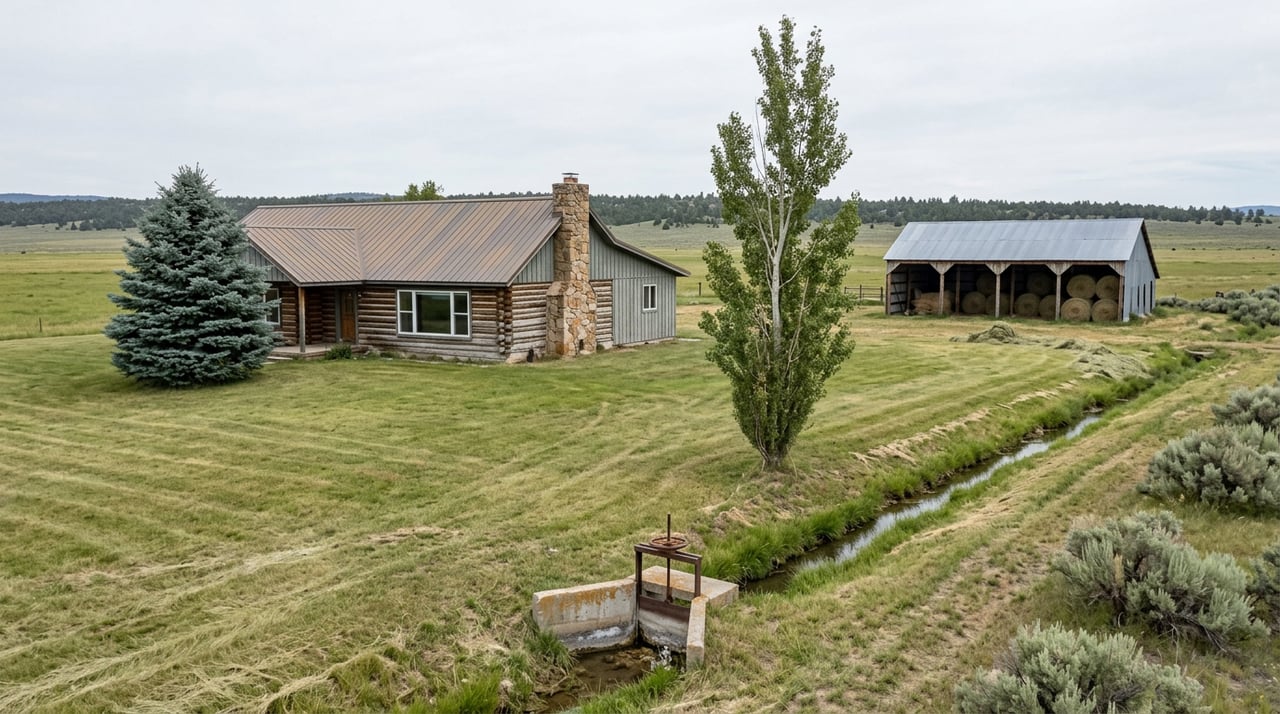
In Crawford, the Ranch Sells on One Deed. The Water Sells on Another.
September 17, 2026
September 17, 2026
"We just kept buying."
That's Christy Hawk, describing how she and her husband Darold turned 40 acres and five cows into a working cattle ranch of more than 440 acres at the base of Needle Rock in Crawford. The family bought the original parcel in 1951. Seventy-some years later, when the Hawks sat down to place a conservation easement on the ranch, the land wasn't the complicated part. The water was.
That's the piece most guides to buying rural Colorado property skip past with a line like "confirm water rights before closing." True, but vague enough to be useless. Here's what actually happens in Crawford: the ranch and the water run through two separate systems of ownership, two separate paper trails, and two separate approval processes, and only one of them is the deed you sign at the title company.
Colorado treats water as a distinct form of real property, adjudicated and administered under a doctrine that has nothing to do with who holds title to the dirt. A water right in Colorado is regarded as a real property interest similar to land for purposes of ownership and conveyancing, and it can be conveyed with the land or held back from it entirely. That second option, severance, is legal and not uncommon, which is why a buyer can close on acreage and still end up without a drop of legal water access if nobody checked.
The Colorado Real Estate Commission's standard Contract to Buy-Sell accounts for this by including a dedicated section where the parties describe exactly which water rights are changing hands: decreed rights, shares in a mutual ditch or reservoir company, or groundwater from a well. If that section is left vague or blank, you haven't necessarily lost the water, but you also haven't necessarily kept it. Someone has to spell it out.
Here's the part that surprises out-of-state buyers most: there's no statewide ownership registry that ties water rights to a specific parcel. You can't look up a Crawford address and see its water attached the way you'd check a property tax record. The deed history at the county clerk's office may hint at it. The definitive answer sits in the shareholder registry of whichever ditch company serves that ground.
If you're buying or selling irrigated land around Crawford, there's a good chance the water traces back to one of a small handful of local mutual companies: the Crawford Clipper Ditch Company, the Fruitland Irrigation Company, or the Fruitland Domestic Water Company, all based right in Crawford and administered under the Gunnison River Basin. These aren't abstractions. They're the actual entities that decide whether the water that's watered that pasture for decades keeps doing so under a new owner's name.
Transferring shares in one of these companies isn't a line item in the closing package. It's its own process, run entirely outside the title company:
| Water source | How it transfers | Who processes it |
|---|---|---|
| Well | Change in Owner form filed at or shortly after closing | Colorado Division of Water Resources |
| Mutual ditch shares (Crawford Clipper, Fruitland Irrigation) | Assignment form or slip assignment for the stock certificate | The ditch company itself, which reissues a new certificate and updates its stockholder registry |
| Decreed surface right | Description in the deed, or a separate water deed recorded alongside it | County clerk and recorder |
A ditch company's registry is its own record of truth. If a previous owner sold off shares years ago and never told anyone, that gap won't show up in a routine title search. It shows up when the new owner calls the ditch company in April expecting water and gets told the shares moved to someone else's name a decade ago. Title companies that specialize in agricultural closings routinely flag exactly this kind of unrecorded assignment during due diligence, because standard title searches aren't built to catch it.
Shareholders also owe the ditch company annual assessments to fund maintenance and operation of the system. That's a small recurring cost, but it's one more thing that needs to move cleanly from seller to buyer, and one more reason to call the company directly rather than assume the paperwork handles itself.
One of the more scenic pieces of ranch land near Crawford, a property along Smith Fork Creek not far from Black Canyon of the Gunnison National Park, illustrates a distinction every buyer in this valley eventually needs to understand: a stream crossing your land and a legal right to use that stream's water are not the same thing.
Colorado's prior appropriation system means the water in that creek may already be spoken for by someone with a decree dated decades before you ever saw the listing. Owning the streambank doesn't grant you the right to divert from it. That right has to be decreed, adjudicated through water court, and documented, independent of who owns the land it flows through. A trout stream through a meadow is a beautiful selling point. It is not, on its own, an irrigation plan.
This is why buyers who assume "there's a creek, so there's water" get an unwelcome education after closing. The reverse is also true: a well on the property doesn't necessarily authorize irrigation. A domestic well is typically permitted only for the approved dwelling it serves, and whether it can legally water a garden or a pasture depends entirely on the terms of that specific permit.
Go back to the Hawks. Their ranch sits on land the family has worked since 1951, and it also carries a grazing permit in the West Elk Wilderness. When they partnered with Colorado West Land Trust to place a conservation easement on the property, the water wasn't an afterthought folded into the land description. It was its own line of due diligence, documented separately from the acreage itself.
The same pattern showed up on another Crawford-area ranch that Colorado West Land Trust worked to conserve in 2020, a property adjacent to Gunnison National Forest land that included 500 acres of irrigated ground and what a Great Outdoors Colorado program officer described as significant junior water rights, along with two and a half miles of creek frontage. Junior rights matter because of where they sit in the priority line during a dry year, but the point for a buyer or seller isn't the priority date itself. It's that even in a transaction backed by a land trust, a state grant program, and Colorado Parks and Wildlife funding, the water still had to be identified, valued, and documented on its own terms, separate from the acreage it irrigated.
If families who've ranched the same ground for generations and organizations that do this professionally still treat water as its own asset requiring its own paperwork, that's a strong signal for anyone newer to the process. There's no shortcut where the land deed quietly covers the water too.
None of this needs to derail a sale. It does need to start early. Confirming ditch company records, verifying well permit status with the Division of Water Resources, and reviewing whether a decreed right is being sold with the land or held back are steps that take real calendar time, and they're steps that can't be rushed through in the final week before closing. Building that confirmation into your contract timeline, rather than assuming it as a formality, is the difference between a closing that goes smoothly and one that gets extended at the last minute over a stock certificate nobody thought to check.
Does buying acreage near Crawford automatically include the water rights? Not necessarily. Water rights can be conveyed with the land or reserved separately by the seller. The Colorado contract to buy and sell real estate requires the parties to spell out exactly which water rights, if any, are included, so this needs to be addressed directly rather than assumed.
If there's a well on the property, does that cover irrigation too? Only if the well permit says so. A domestic well is typically approved for the specific dwelling it serves, and outdoor irrigation use depends on the terms of that individual permit, not on the mere presence of a well.
Who do I actually call to confirm ditch shares are legitimate and transferable? The ditch company itself, not the county. Companies like the Crawford Clipper Ditch Company and Fruitland Irrigation Company maintain their own stockholder registries, and that registry, not the county recorder, is the definitive record of who currently holds the shares.
Land and water are two different assets in Crawford, and treating them that way from the first conversation, not the last week before closing, is what keeps a ranch or acreage sale on schedule. If you're weighing a purchase or preparing to sell irrigated ground in the North Fork Valley, Needlerock Mountain Realty has spent decades working this exact kind of transaction from both sides of the table. Find Your Place in Colorado.
Stay up to date on the latest real estate trends.



A home, a ranch, a mountain retreat, or a thriving farm—every property represents a different way of life. Our team is passionate about helping clients discover the land, lifestyle, and opportunities that make Western Colorado extraordinary.

NEEDLEROCK MOUNTAIN REALTY & LAND, LLC
[email protected]
OPEN HOURS
MONDAY - FRIDAY: 9:30 AM TO 5:00 PM
CRAWFORD OFFICE
380 HIGHWAY 92
CRAWFORD, CO 81415
(970) 921-5331
PAONIA OFFICE
236 GRAND AVE
PAONIA, CO 81428
(970) 527-5331