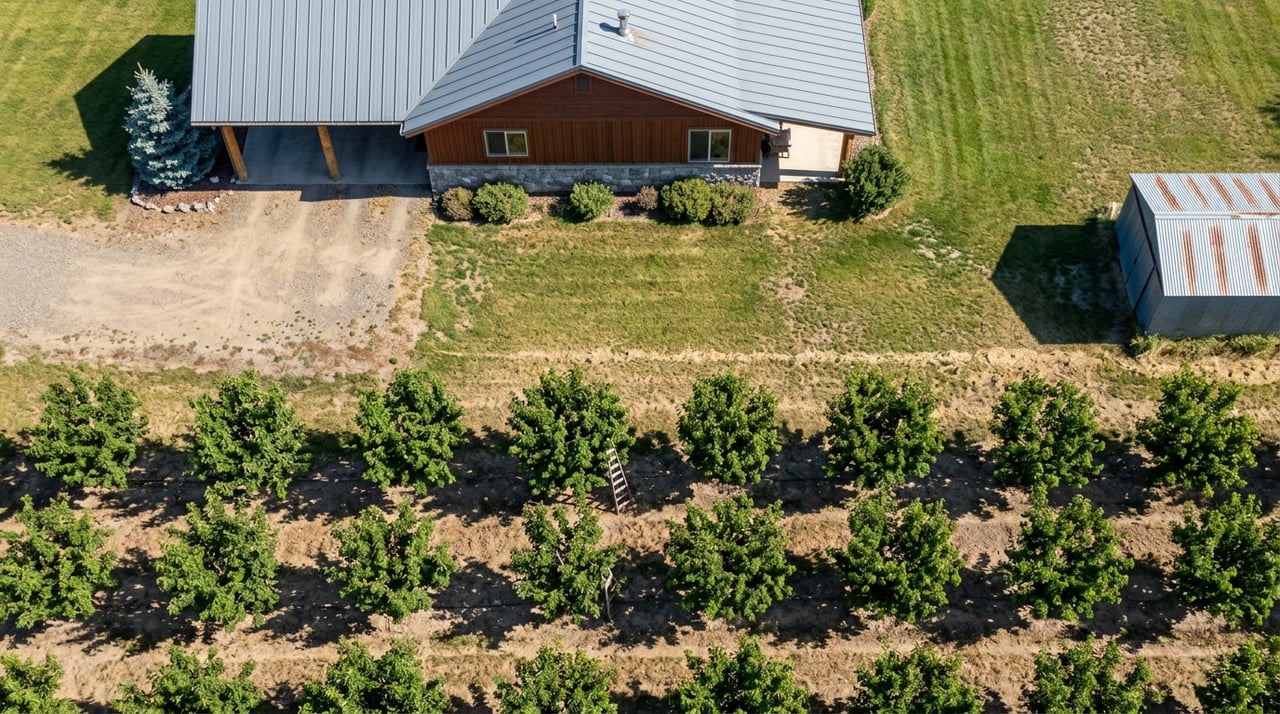
In Paonia, Buying the Orchard Doesn't Always Mean Buying What's Under It
August 27, 2026
August 27, 2026
The title commitment lands a week or two after you go under contract, usually as a PDF nobody reads past the first page. Schedule A confirms the seller, the price, the legal description. Schedule B is where things get interesting, and in the North Fork Valley, Schedule B Section 2 has a habit of saying something buyers from other parts of the country rarely expect: that a mineral estate has been severed from the surface, and there is a substantial likelihood someone else holds oil, gas, or other mineral rights beneath the property they are about to close on.
Most buyers skim past it. The deal still closes. The financing still goes through. But the assumption that comes standard with most American real estate, that buying the surface means buying everything below it, does not hold the same way here. In Paonia and across Delta County, what you own when you sign at closing depends on a century of coal leases, homestead patents, and paperwork that predates most of the orchards on the market today.
What makes the North Fork Valley a repeat case is that two separate historical forces stacked on top of each other.
The first is federal. Land patented under the Stock Raising Homestead Act of 1916 came with subsurface minerals reserved to the federal government from the start. Settlers got 640 acres of grazing land and nothing beneath it. A lot of Western Slope acreage traces back to an SRHA patent, which means the split was built in before a private buyer ever touched the deed.
The second is local and more recent. Coal mining grew up alongside the same ranches and orchards that define this valley today, and at its height it ran three mines at once: the Bowie #2 loadout northeast of Paonia, the Oxbow-operated Elk Creek Mine with its loadout just north of Somerset, and the West Elk Mine a mile east of Somerset. A Colorado Public Radio report says that in January 2010, those three mines employed 950 coal miners. Elk Creek closed in 2012 after a mine fire, Bowie #2 shut down as coal-fired power lost ground nationally, and by January 2017 the valley was down to about 220 workers at a single remaining mine. West Elk is the one still running today, and as of a Grand Junction Sentinel report on state production data, it grew output to about 3.7 million tons in 2024 and remains Colorado's top coal producer. It's now owned by Core Natural Resources, formed in January 2025 when Arch Resources merged with CONSOL Energy.
A century of coal leasing across private and federal land in one valley leaves a paper trail. Every sale, lease, or reservation tied to that industry gets recorded at the Delta County Clerk and Recorder's office.
Here's the part that catches people off guard. Colorado follows the common law rule that the mineral estate is dominant over the surface estate. If someone else owns the minerals under your land, they generally have the legal right to enter and use as much of the surface as is reasonably necessary to get to what's theirs, without needing your permission first.
That doesn't mean a drill rig is showing up in your hay meadow next spring. Most severed mineral interests in this valley sit dormant, tied to old coal leases or family reservations from generations back. But it does mean the ownership you're buying is narrower than "I own this property" suggests.
| Surface Estate | Mineral Estate | |
|---|---|---|
| Includes | House, barn, orchard, pasture | Oil, gas, coal, and other subsurface resources |
| Access rights | Use of the land itself | Right to enter and use the surface as reasonably necessary to extract minerals |
| How it's flagged | Rarely appears as an issue | Shows up as a Schedule B-2 exception on the title commitment |
Colorado doesn't leave this to chance in the paperwork. Colorado Revised Statutes § 10-11-123 requires a title company to add specific language to any commitment where a severance turns up, stating plainly that a third party may hold mineral interests and that those rights can include access to the surface without the owner's consent. Frascona explains that the standard Colorado contract to buy and sell real estate carries its own warning in capital letters, telling buyers up front that the surface and minerals may be owned separately and that oil and gas activity could occur on or near the property. It's there so nobody can say later they weren't told.
None of this means walk away from the deal. It means treat the title commitment as a document worth reading closely, not a formality to sign past.
If you want to see how the county itself treats this, the Delta County Assessor's office has a whole process for surface owners who want a severed mineral interest formally placed on the tax roll, requiring a complete chain of title from the original federal patent forward. That a county department maintains a standing procedure for this tells you it's a routine part of doing business here, not a rare edge case.
Coal built more of this valley's middle class than most transplants realize. The miner statue standing in Paonia Town Park was funded by local mining families and committees in 1981 and 1982, raised in part to honor those lost in the industry, including the fifteen killed in the 1981 Dutch Creek Mine No. 1 explosion outside Redstone. The coexistence of coal country and fruit country isn't a contradiction here. It's the reason the paperwork looks the way it does.
Does a severed mineral estate mean someone can start drilling on my land? Not automatically. Most severed interests in this valley are inactive, tied to historic leases. Active development requires permits and, in many cases, a surface use agreement, but the mineral owner does hold the legal right to reasonable access.
Will this affect my ability to get a mortgage? Rarely. Lenders in Delta County see this exception often enough that it's a known quantity, not a red flag that stalls underwriting on its own.
Does this apply to every property in Paonia, including in-town lots? No. It shows up far more often on larger acreage, orchard ground, and rural parcels with roots in older land patents than on small in-town residential lots, though it's always worth checking the title commitment either way.
Land here has always meant more than the fence lines suggest. Water rights, ditch shares, and now mineral history all shape what you're actually buying, and none of it shows up on a listing photo. If you're evaluating a property in the North Fork Valley and want someone who can read a title commitment the way a local reads a weather pattern, Needlerock Mountain Realty has spent decades untangling exactly this kind of paperwork for buyers and sellers across Paonia and the surrounding valley. Find Your Place in Colorado.
This article is general information, not legal, tax or financial advice. Consult a qualified professional about your situation.
Stay up to date on the latest real estate trends.
A home, a ranch, a mountain retreat, or a thriving farm—every property represents a different way of life. Our team is passionate about helping clients discover the land, lifestyle, and opportunities that make Western Colorado extraordinary.

NEEDLEROCK MOUNTAIN REALTY & LAND, LLC
[email protected]
OPEN HOURS
MONDAY - FRIDAY: 9:30 AM TO 5:00 PM
CRAWFORD OFFICE
380 HIGHWAY 92
CRAWFORD, CO 81415
(970) 921-5331
PAONIA OFFICE
236 GRAND AVE
PAONIA, CO 81428
(970) 527-5331