In Cedaredge, the Slope That Saves the Orchard Is the Same One That Sets the Price
September 3, 2026
September 3, 2026
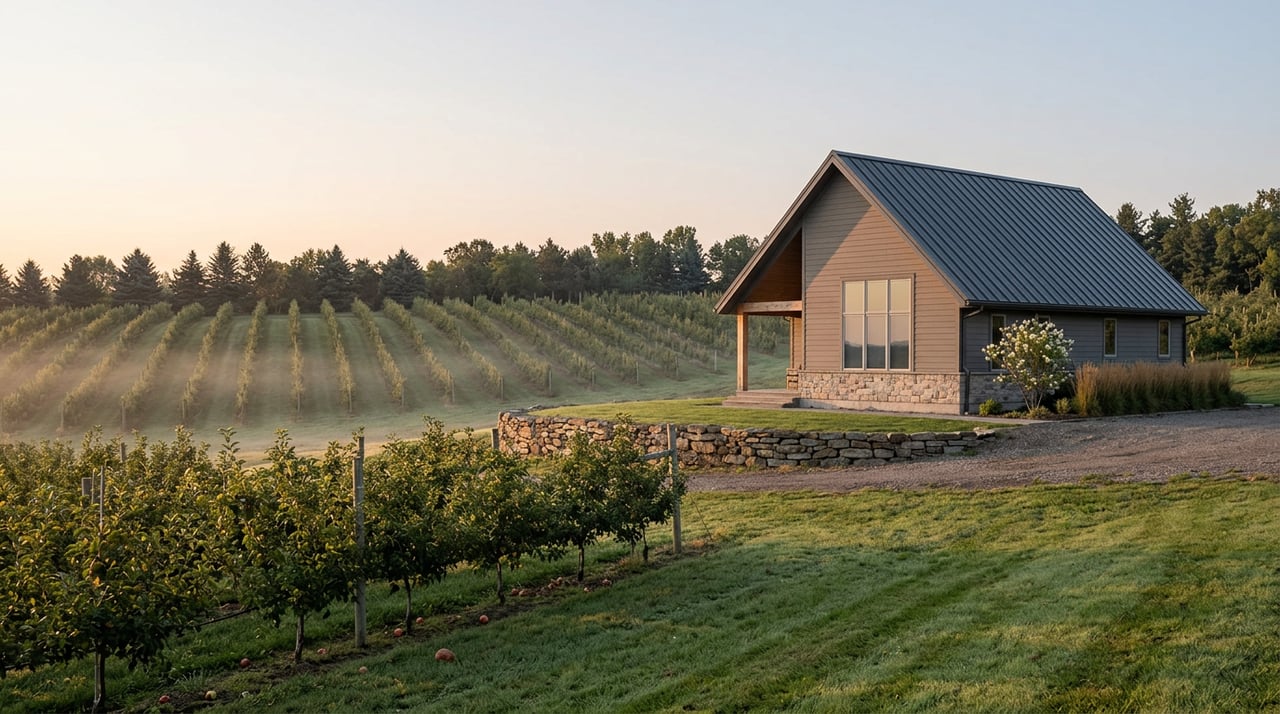
Drive Highway 65 north out of downtown Cedaredge in early spring and you will pass two kinds of ground for sale within a mile of each other. One parcel sits close to Surface Creek, flat, easy to fence, and priced to move. The other climbs a little, onto Cedar Mesa or the rise behind Deer Creek Villages, and costs more for what looks like the same acreage and roughly the same view north to the Grand Mesa. Ask why, and the listing copy almost always lands on some version of the same phrase: elevated topography, desirable homesite. Nobody explains what that phrase is actually protecting against.
It shows up so often in Cedaredge and Surface Creek Valley listings that it has become background noise, the real estate equivalent of "cozy" or "must see." Buyers read it as a scenery upsell, a nicer view for a nicer price. In practice, on this particular ground, it is describing something closer to insurance.
The mechanism is simple once someone points it out, and almost nobody does. Cold air is denser than warm air, so on a clear, still night it behaves the way water does. It flows downhill and collects in the lowest available spot, whether that spot is a ditch, a creek bottom, or the flattest part of a valley floor. A homesite a few dozen feet higher on a slope can sit in air that is measurably warmer than a homesite in the bottom, even though the two are close enough to share a fence line and a mailing address.
That is why a river bottom or valley floor lot can see frost weeks after a neighboring lot on slightly higher ground has cleared for the season. It is also why the fruit belt of western Colorado was never planted at random. Growers have known for generations that the safest ground for a peach or apple tree is the bench, not the bottom, because the bench drains its cold air away overnight instead of pooling it around the blossoms.
Delta County did not have to take this on faith in 2026. In May, a hard, long-lasting freeze hit the North Fork Valley and landed squarely on Ela Family Farms, a hundred-acre operation near Hotchkiss that sits at roughly 5,800 feet, more than a thousand feet higher than Palisade, the Western Slope's best-known peach country. The crew ran wind machines to pull warmer air down onto the trees and applied an experimental mineral treatment developed at Colorado State University's nearby Rogers Mesa research station. Neither worked. The farm, which manages more than 30,000 peach, apple, pear, plum, and cherry trees, lost the bulk of its crop.
Meanwhile, Palisade came through largely unscathed. Growers there credit what they call the Million Dollar Breeze, a down-valley wind that pulls warmer canyon air through the orchards on the coldest nights and keeps frost from settling. Same week, same general freeze, two very different outcomes on opposite ends of Delta and Mesa county peach country, and the difference came down to how each valley moves its cold air.
CSU's own numbers make the pattern concrete. The Rogers Mesa research station, three miles west of Hotchkiss at 5,800 feet, runs a certified organic research farm with an average frost-free growing season of 125 days. Down in the Grand Valley near Grand Junction and Palisade, at elevations roughly a thousand feet lower, university research stations report growing seasons stretching well past 150 days. Elevation alone is not destiny. Rogers Mesa still lost its blossoms this past spring despite every intervention available. But elevation sets the baseline everyone else is working against, and a thousand feet of difference is not a rounding error. It is closer to a month of growing season.
| Site | Elevation | Average frost-free season | What it shows |
|---|---|---|---|
| CSU Rogers Mesa research farm, near Hotchkiss | 5,800 ft | 125 days | Even with wind machines running, this spring's freeze still won |
| Grand Valley research stations, near Grand Junction and Palisade | more than 1,000 ft lower | 150+ days | Lower elevation and the Million Dollar Breeze both worked in the growers' favor |
Cedaredge is not Hotchkiss and Surface Creek Valley is not the North Fork, but the physics does not stop at a county line. Cedaredge itself sits at an elevated vantage tucked beneath the Grand Mesa's southern slopes, and inside the valley there is the same small-scale variation that decided the Talbott and Ela farms' spring. Surface Creek runs the length of the valley, and the ground closest to it sits lower, flatter, and colder on a clear night than the benches rising above it, the same benches where Cedar Mesa and Deer Creek Villages sit.
That is the real story behind every listing that mentions elevated topography. It is not marketing filler. It is a shorthand for a homesite that drains cold air instead of collecting it, which matters for more than curb appeal. A garden planted on a bench has a real shot at clearing spring frost a week or two earlier than one planted in the bottom. Fruit trees, a common addition on acreage here, bloom into that same window and either catch a killing frost or dodge it depending on which side of that line they sit. Even something as basic as a cold, foggy morning lingers longer at the bottom of the valley than it does a few hundred feet up the slope.
None of this means valley-bottom land is a bad buy. Flatter ground is often easier and cheaper to build on, closer to the creek for irrigation, and priced accordingly. It means the price gap between a bottom parcel and a bench parcel of similar size is not just paying for a better photo. It is paying for a real, physical difference in how that ground behaves on the coldest nights of the year.
A buyer comparing two Cedaredge parcels can settle most of this with a few direct questions rather than trusting the listing description:
These are not questions a title search or an appraisal will answer. They come from knowing the valley, walking the ground at different times of day, and understanding why an orchardist in Hotchkiss and a homebuilder in Cedaredge are, in a real sense, worried about the same thing on a cold clear night.
Does "elevated" always mean safer from frost? Generally, yes, relative to the ground immediately around it, but elevation is not a guarantee on its own. Rogers Mesa sits well above Palisade and still lost its crop this past spring. What elevation buys is better odds, not certainty.
Does this only matter if I plan to garden or grow fruit? No. The same cold air pooling that threatens blossoms also means colder mornings, later-lingering frost on driveways and walkways, and a harder push for anything you plant around a new home. It is a livability question as much as an agricultural one.
Buying acreage in the Surface Creek Valley means reading the ground the way a grower does, not just the way a real estate listing does. If you are comparing lots around Cedaredge and want someone to walk them with you and talk through what the slope is actually telling you, Needlerock Mountain Realty would be glad to help you find your place in Colorado.
Stay up to date on the latest real estate trends.
A home, a ranch, a mountain retreat, or a thriving farm—every property represents a different way of life. Our team is passionate about helping clients discover the land, lifestyle, and opportunities that make Western Colorado extraordinary.

NEEDLEROCK MOUNTAIN REALTY & LAND, LLC
[email protected]
OPEN HOURS
MONDAY - FRIDAY: 9:30 AM TO 5:00 PM
CRAWFORD OFFICE
380 HIGHWAY 92
CRAWFORD, CO 81415
(970) 921-5331
PAONIA OFFICE
236 GRAND AVE
PAONIA, CO 81428
(970) 527-5331