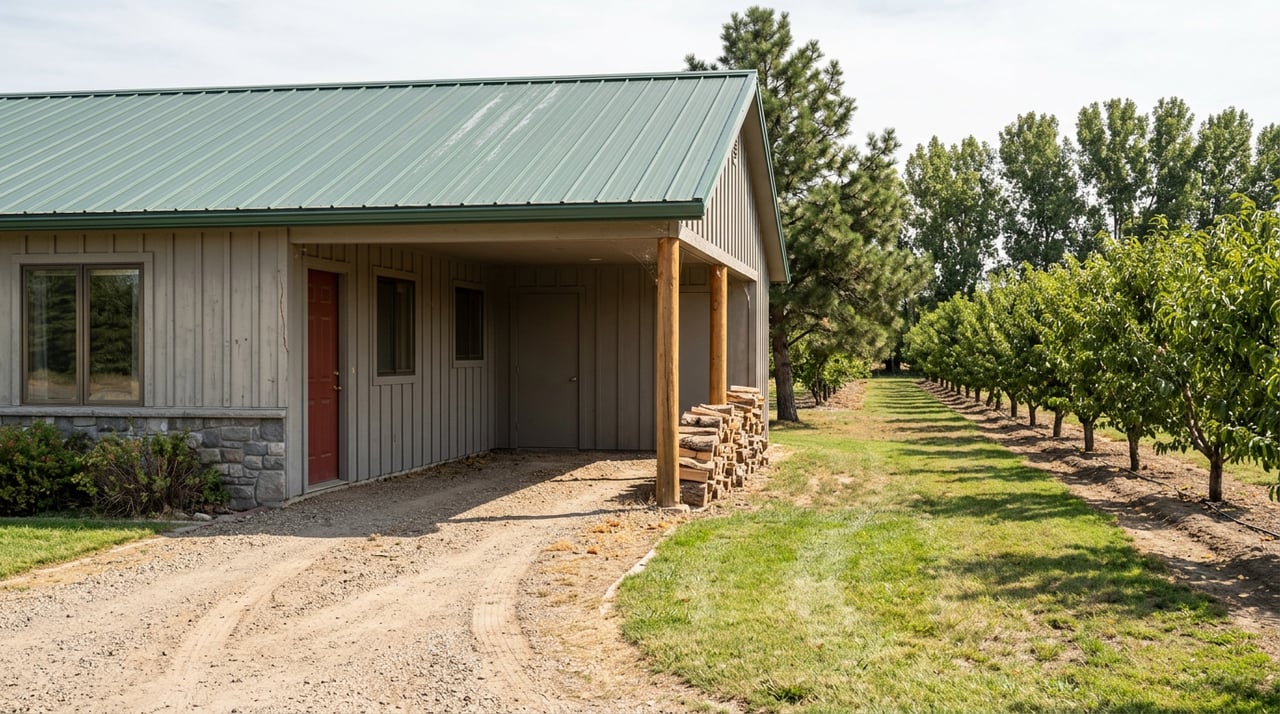
In Orchard City, the Water Tap Decides What Gets Built, Not the Zoning Map
August 13, 2026
August 13, 2026
Ron Klein had already spent $62,000 on water taps when the county told him he needed one more.
Klein owns the Orchard Mesa Estates subdivision, and by the time he brought his case to the Orchard City Board of Trustees in February 2025, he'd purchased four taps for the property and thought he was done. Then Delta County came back and said the final plat wouldn't move forward without a fifth. "The county has put me in a tough spot," Klein told the board. "I've got $62,000 invested in water taps. Now the county's telling me I need one more." The timing made it worse: trustees were about to vote on a resolution that would freeze new tap approvals altogether. They approved his fifth tap because the subdivision's taps had already been in motion, then passed the moratorium anyway.
That sequence, one property owner squeaking through right before the door closed, is the clearest window into how building actually works in Orchard City. It isn't the zoning map or the size of the parcel that decides whether you can put up a house. It's whether the town's water department has a tap to give you.
Orchard City runs its own municipal water system, and by its own description on the town's site, that system provides domestic water only, not irrigation. It's a small utility serving a town of a little over 3,000 people spread across the old communities of Austin, Eckert, and Cory, and it has spent the past year and a half absorbing drought, aging infrastructure, and water loss all at once.
The town's own reporting backs that up. At an April 2026 trustee meeting, the mayor pro tem reported that a systemwide audit showed an estimated 10 percent water loss, an improvement over the month before but still a meaningful leak in a system this size. A leak-detection sweep was scheduled for the end of April. None of that is dramatic on its own. Together, it explains why the board keeps reaching for the same tool: stop adding new connections until the math works again.
If you only look at one drought declaration, this reads like a normal, temporary response to a dry year. Strung together, it reads like a pattern:
Fourteen months, at minimum three separate actions, one continuous message. Whether the town formally calls it a moratorium or a drought restriction, the practical effect for anyone trying to add a rooftop is the same: don't count on a new domestic tap showing up on schedule.
The January 2026 denial is worth sitting with, because it wasn't a stranger asking for something unreasonable. It was a property owner who already had water service, asking only to make the pipe slightly larger. Trustee Wade Kasman explained the board's thinking plainly:
"The Water Committee recommendation is no; that's at this time. The reason behind the no is the conditions up on the Mesa right now."
If the town is turning down a tap upgrade for one duplex, a buyer eyeing a raw parcel with no tap at all should not assume the process will be quick or automatic, even if the drought eventually breaks.
Here's where the confusion usually starts for anyone shopping land in this part of the Surface Creek Valley. Orchard City's municipal system is not the same water that irrigates the orchards the town is named for. That water runs through the Orchard City Irrigation District, a separate entity with its own board, its own delivery schedule, and its own contract and share system for landowners inside the district. The district's own site shows how granular that scheduling gets: orders placed Tuesday can run 2, 5, or 7 days; orders placed Thursday for Friday delivery must run exactly three days; minimum volume is a quarter cubic foot per second per day.
A parcel can carry excellent irrigation shares through OCID, enough to keep an orchard or a hay field productive for decades, and still have zero path to a domestic tap for a house. Those are two different systems, two different boards, and two different kinds of scarcity. Strong irrigation rights tell you the land can grow something. They tell you nothing about whether the town can hook up a kitchen sink.
Anyone comparing an acre in Orchard City against an acre in Cedaredge or Delta is usually comparing price against price, maybe view against view. The number that actually separates a buildable lot from a stalled one doesn't show up in that comparison at all: does the parcel already carry an active domestic tap, or would it need a new one from a town that has spent most of the past eighteen months not issuing them.
A lot with a tap already attached, even an old one on a modest ¾-inch line, carries a kind of value that a per-acre price doesn't capture. A lot without one is a bet that the board lifts the freeze, that the leak-detection work pays off, and that your application lands after supply, not demand.
The town isn't unaware of this. In January 2026, Orchard City joined Cedaredge and Delta County in assigning a housing needs assessment to Ayres Associates, the same public meeting where the paper's headline noted the town's moratorium on selling water taps and meters. A town doesn't commission a regional housing study because water is a footnote. It commissions one because the two problems, not enough housing and not enough water headroom, are tangled together, and everyone at the table knows it.
If you're looking at raw or lightly improved land in Orchard City, a few questions will tell you more than the listing sheet ever will:
None of these questions show up on a Zillow filter. All of them show up in board minutes, town correspondence, and the kind of local memory that takes years to build.
Is the water tap moratorium still in effect right now? As of the most recent town action, an April 29, 2026 drought declaration, new municipal connections are not being authorized. The board has said conservation measures will be reduced or terminated by written resolution once the water shortage is abated, but no such resolution has been issued as of this writing.
Does having irrigation shares through OCID help me get a domestic tap faster? No. The two systems are administered separately, and the town's own restriction on domestic connections applies regardless of what irrigation water a parcel already carries.
If I buy land now, can I just wait out the moratorium? Possibly, but the town's own history suggests these restrictions have run in overlapping waves for over a year, and even minor requests, like upsizing an existing tap, have been denied as recently as January 2026. A property already carrying an active tap removes that uncertainty entirely.
Land in the Surface Creek Valley still has plenty to offer, orchard ground, mountain views, small-town pace. The water question just needs to be asked early, not discovered at closing. If you're weighing a parcel here against options in Cedaredge, Delta, or elsewhere on the Western Slope, Needlerock Mountain Realty can help you check tap status and water history before you get attached to a lot that isn't ready to build on. Find Your Place in Colorado.
Stay up to date on the latest real estate trends.
A home, a ranch, a mountain retreat, or a thriving farm—every property represents a different way of life. Our team is passionate about helping clients discover the land, lifestyle, and opportunities that make Western Colorado extraordinary.

NEEDLEROCK MOUNTAIN REALTY & LAND, LLC
[email protected]
OPEN HOURS
MONDAY - FRIDAY: 9:30 AM TO 5:00 PM
CRAWFORD OFFICE
380 HIGHWAY 92
CRAWFORD, CO 81415
(970) 921-5331
PAONIA OFFICE
236 GRAND AVE
PAONIA, CO 81428
(970) 527-5331